Mineral Ground
Project Entry 002 · Friday 18 September 2026
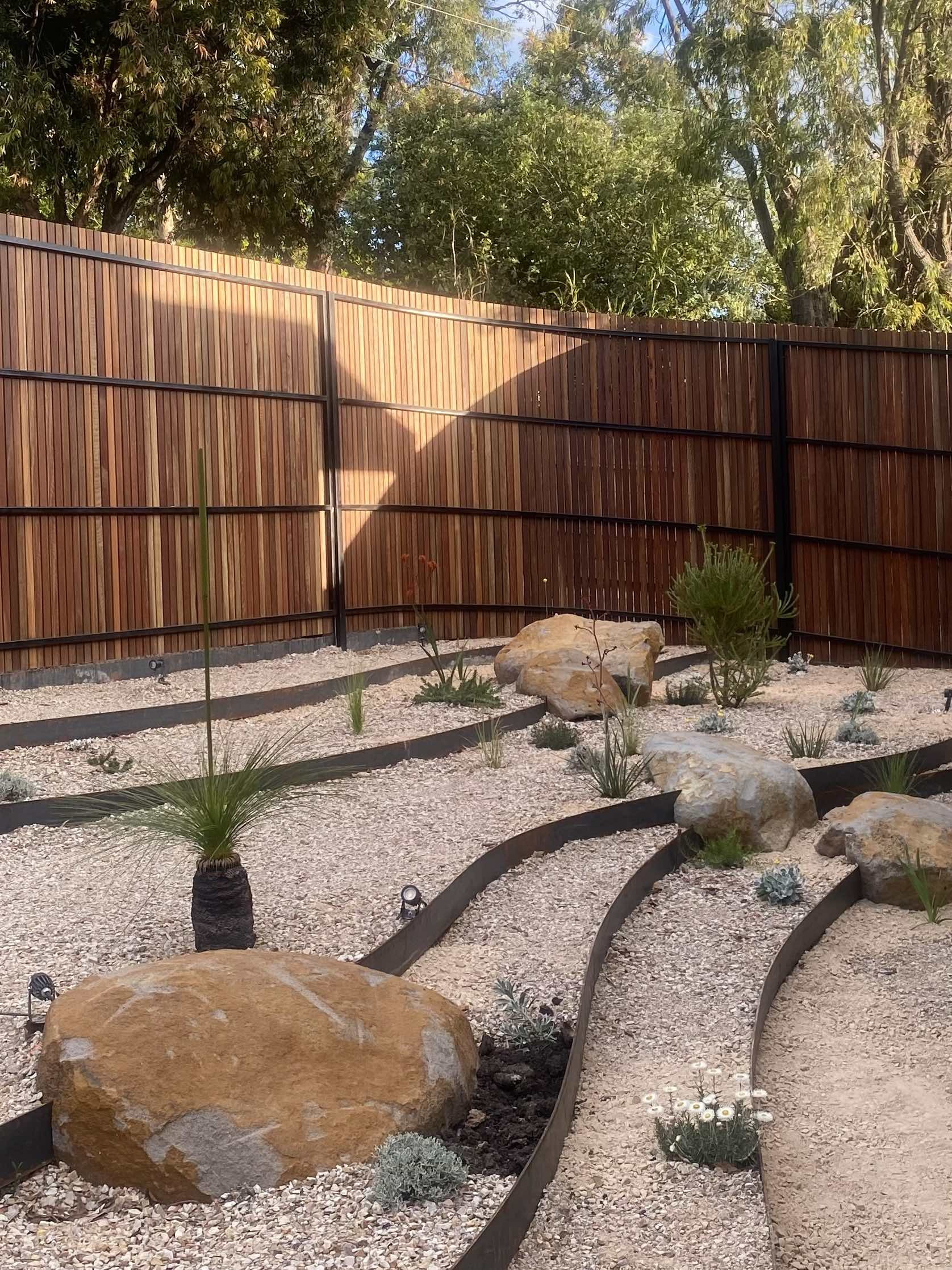
The first layer of Tuscan Topping in November 2024, featuring a gifted grass tree from our landscaper and the first tubestock planting in our terraced courtyard.
Two years after choosing Tuscan Topping for the paths and driveway, the gravel has become part of the garden’s character, carrying memories of other landscapes while the planting grows through it.
Mineral ground.
And a way to make the land more permeable.
When we first planned the garden, I wanted permeable paths. I had lived in Alice Springs, where weekends in a swag made that dry, mineral landscape part of my visual memory. At the same time, I wanted the ground here to feel connected to the creek landscape below us, loose and natural rather than paved and sealed.
Our landscape designer consulted with us about using Tuscan Topping, but I had imagined something closer to granitic sand. When it arrived, the amount of rock and the yellow dust surprised me.
Freshly laid, it was much yellower than I had expected, with the fine dust coating everything and disguising much of what was underneath. Then it rained. The yellow washed away, and suddenly the paths were full of colour, with ochres, greys, browns, rusts and pale stones appearing through the surface like a kaleidoscope. It was one of those moments when a material I hadn’t quite understood became far more interesting once the weather got hold of it.
Not everyone was convinced. In those first months, the garden was mostly gravel and tiny tube stock, and the planting had barely begun to register against all that exposed ground. The effect was confronting for some people in the street. One little girl looked across at it and announced that it “looks like a bad desert garden.”
We never thought it was a bad desert garden, but I understood why she saw it that way. At that stage, the plants were too small to show what the garden would become. I kept assuring people that they would grow and the whole thing would soften. The mineral ground was never intended to be the garden. Rather, it was the structure the garden would grow through.
Perhaps I should not have been surprised by how much I came to like it. Gravel has appeared around more than one house I have loved. As a child, I lived in a seventies Fasham Johnson house surrounded by a native garden. The Lilydale Topping driveway entrance was lined with railway sleepers and red kangaroo paw, and that way of approaching a house through a landscape has stayed with me.
Later, the house Jay and I lived in before this one had a gravel front garden, with proteas, a cherry tree and a dwarf apple tree lining the entrance so that you felt immersed in the garden from the moment you set foot inside. I also loved the way you could hear people walking up the gravel before they reached the door. Their arrival announced itself underfoot.
But when we were planning this garden, accessibility mattered too. I had explained to the landscape designers that loose gravel could be tiring to walk through, and we didn’t want the paths to be difficult for Dad or me to navigate. The Tuscan Topping here is much more compacted, so we do not get quite the same sound, but it is considerably easier to move across.
That balance between the character of gravel and the practicality of a firmer surface is perhaps most apparent in the driveway. Rather than treating it as separate from the garden, the same mineral ground continues through it, so the experience of arriving home begins before you even step out of the car.
There is something about hearing the tyres move across it as we arrive home, then stepping out onto the gravel, that changes the feeling of the place. To me, it feels more like arriving at a country home than pulling into a suburban driveway. For a moment, I no longer feel as though we are twenty minutes from the city.
We made a similar decision at the street edge. Instead of keeping the conventional grass nature strip, we took part in our local council’s incentivised native nature-strip planting scheme. That was another change some people struggled with (which I’ll write about in the future), but for us replacing the lawn made sense. There is no edging and mowing to keep up with, no strip of grass turning brown through summer, and the nature strip has become another planted part of the garden rather than something sitting outside it. So many nature strips in the street become untidy or brown at different times of year that, for us, planting ours felt both more useful and more beautiful.
We have now lived with the TuscanTopping for two years. That has meant learning what happens to a permeable surface once it becomes part of everyday life rather than a newly finished landscape.
Cars travel over it, and dogs cross it. Leaves, bark and dried grasses fall onto it. Water finds the low points, parts compact, parts thin, and moss and green growth appear through wet winters. Last year, after drainage problems became apparent, we installed additional drainage through the Terraced Courtyard. Afterwards, Jay and I replenished some of the surface ourselves, with Jay spending two days moving and spreading material, then later topping up other areas to tidy them.
Now the driveway is beginning to wear thin again, particularly where the tyres of our new electric cars repeatedly follow the same line.
The edges are changing too. Along the fence lines, we have always allowed a certain looseness because I do not want the garden sealed away from everything around it. A creek ecosystem runs below us, and I value the movement of insects and other animals through the garden.
However, that openness has one practical limit. Tiger snakes are the main snake species along the creek and, while they belong in that ecosystem, I do not particularly want to make the garden an easy extension of it. Some of the larger gaps along the boundary will therefore be contained a little more carefully this time, while still allowing the garden to remain connected to the life around it.
This September, before another load of Tuscan topping arrives, I have started with the least glamorous part of the job: picking it clean. Every piece of bark, fallen stick, dried grass and bit of leaf litter that has accumulated across the surface is coming out by hand and thrown into our mulched garden beds.
The small patches of green growth that returned over winter will be treated away from the planting, and the existing topping prepared before the new material goes down. It is painstaking work, but I find something satisfying about it. It ultimately means neater paths in the long run.
When the garden was first built, the surface was simply part of the landscape design. Now I know where the water travels, where tyres wear it away, which edges stay clean and which collect debris, and where winter leaves its mark. I also know that what once looked stark enough for a child to call a bad desert garden has gradually become something else.
The garden only needed time to grow through the gravel.