The Build
The making of the garden, from the decisions that shaped the original landscape to the structures and productive layers being added over time.
The Build follows the physical story of the garden. The invitation that brought us here. The brief for the original native garden. The people who designed and built it. The ways access was considered from the beginning, and the beds, growing structures and other interventions now becoming part of the garden.
It moves backwards and forwards through that history, recording how the place was made and how it continues to change.
Mineral Ground
Tuscan topping was not quite the ground I had imagined. Two years on, it has become part of the garden’s character, shaped by memory, accessibility, weather and the planting growing through it.
Project Entry 002 · Friday 18 September 2026
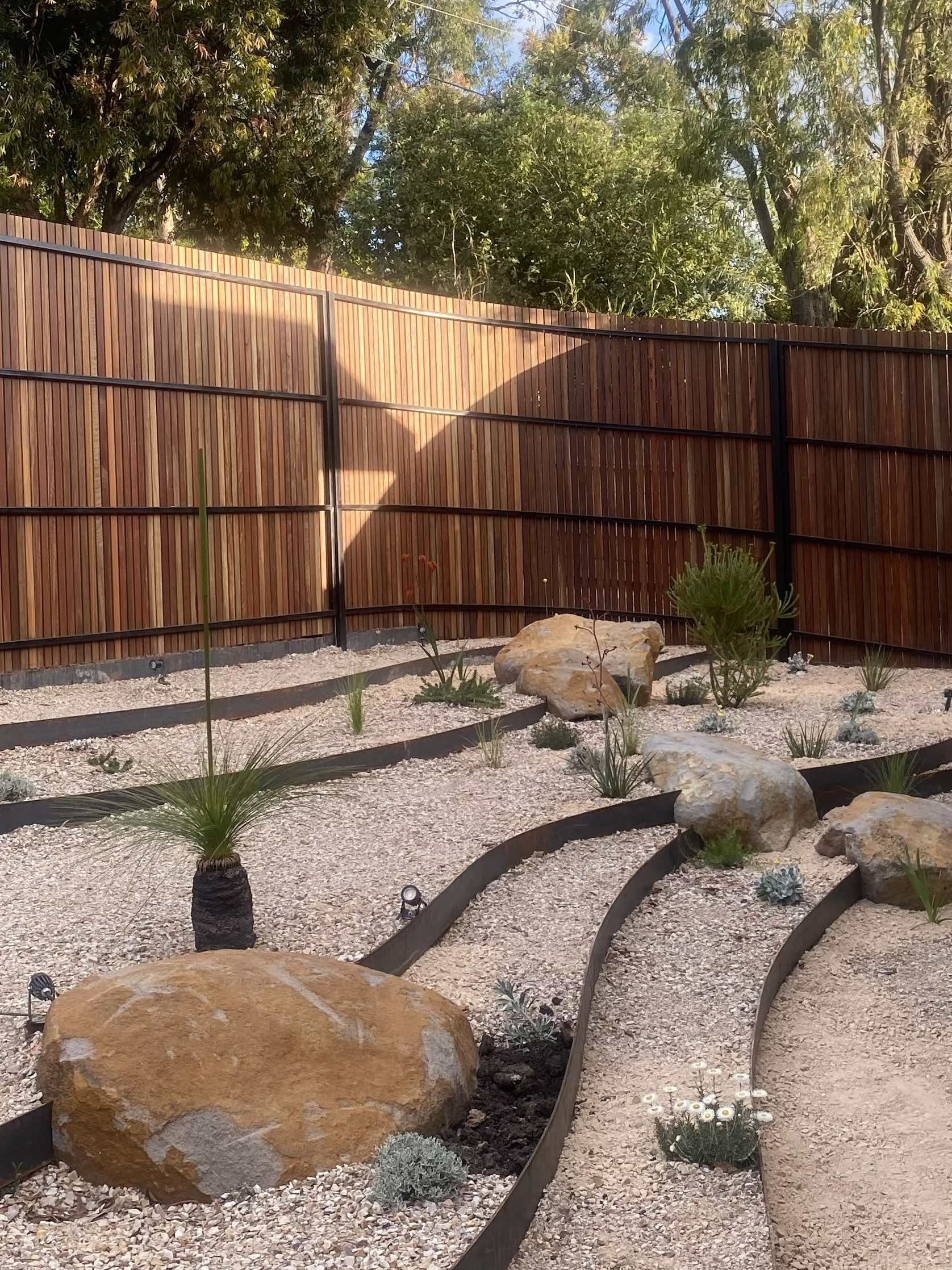
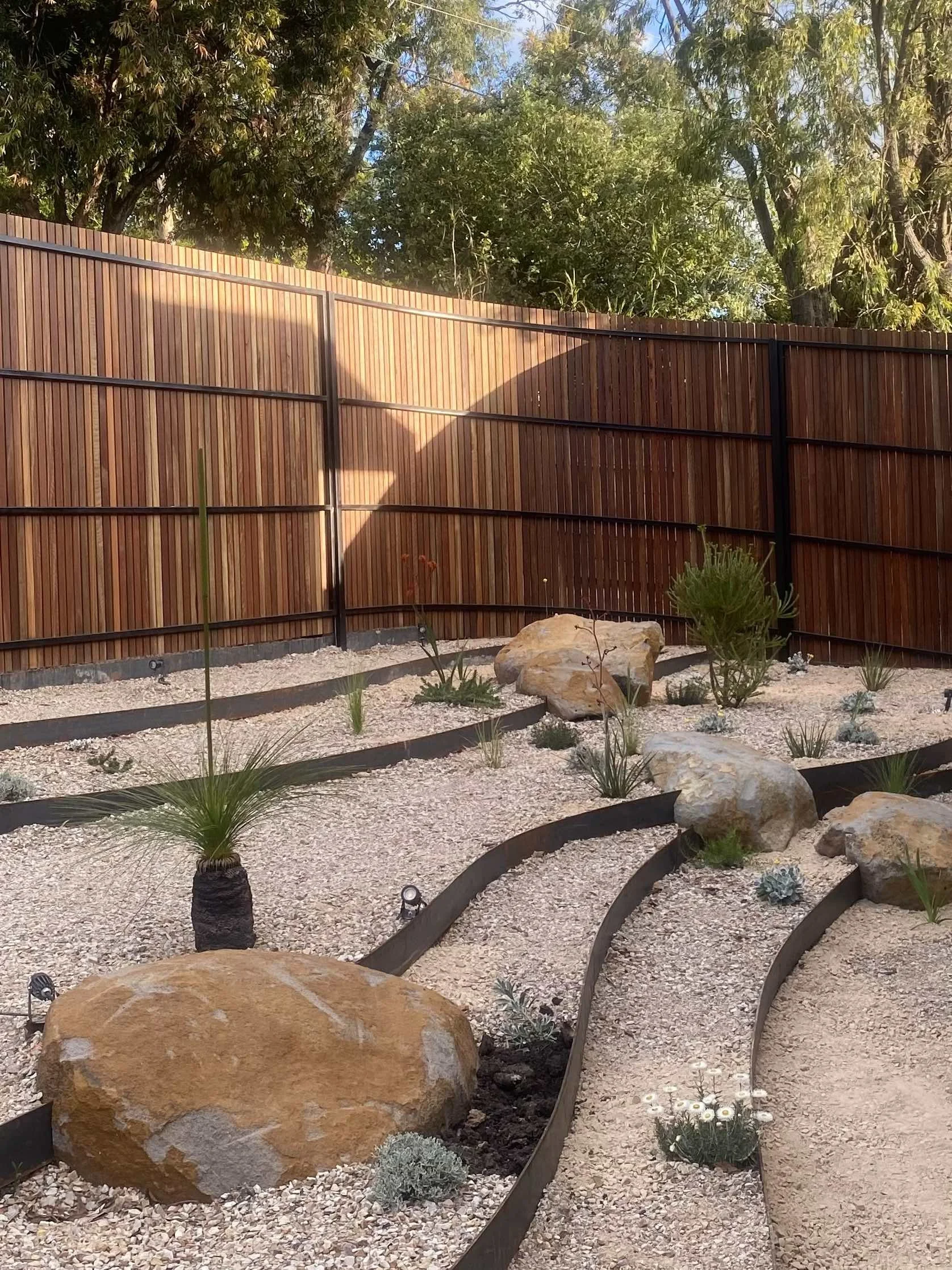
The first layer of Tuscan Topping in November 2024, featuring a gifted grass tree from our landscaper and the first tubestock planting in our terraced courtyard.
Two years after choosing Tuscan Topping for the paths and driveway, the gravel has become part of the garden’s character, carrying memories of other landscapes while the planting grows through it.
Mineral ground.
And a way to make the land more permeable.
When we first planned the garden, I wanted permeable paths. I had lived in Alice Springs, where weekends in a swag made that dry, mineral landscape part of my visual memory. At the same time, I wanted the ground here to feel connected to the creek landscape below us, loose and natural rather than paved and sealed.
Our landscape designer consulted with us about using Tuscan Topping, but I had imagined something closer to granitic sand. When it arrived, the amount of rock and the yellow dust surprised me.
Freshly laid, it was much yellower than I had expected, with the fine dust coating everything and disguising much of what was underneath. Then it rained. The yellow washed away, and suddenly the paths were full of colour, with ochres, greys, browns, rusts and pale stones appearing through the surface like a kaleidoscope. It was one of those moments when a material I hadn’t quite understood became far more interesting once the weather got hold of it.
Not everyone was convinced. In those first months, the garden was mostly gravel and tiny tube stock, and the planting had barely begun to register against all that exposed ground. The effect was confronting for some people in the street. One little girl looked across at it and announced that it “looks like a bad desert garden.”
We never thought it was a bad desert garden, but I understood why she saw it that way. At that stage, the plants were too small to show what the garden would become. I kept assuring people that they would grow and the whole thing would soften. The mineral ground was never intended to be the garden. Rather, it was the structure the garden would grow through.
Perhaps I should not have been surprised by how much I came to like it. Gravel has appeared around more than one house I have loved. As a child, I lived in a seventies Fasham Johnson house surrounded by a native garden. The Lilydale Topping driveway entrance was lined with railway sleepers and red kangaroo paw, and that way of approaching a house through a landscape has stayed with me.
Later, the house Jay and I lived in before this one had a gravel front garden, with proteas, a cherry tree and a dwarf apple tree lining the entrance so that you felt immersed in the garden from the moment you set foot inside. I also loved the way you could hear people walking up the gravel before they reached the door. Their arrival announced itself underfoot.
But when we were planning this garden, accessibility mattered too. I had explained to the landscape designers that loose gravel could be tiring to walk through, and we didn’t want the paths to be difficult for Dad or me to navigate. The Tuscan Topping here is much more compacted, so we do not get quite the same sound, but it is considerably easier to move across.
That balance between the character of gravel and the practicality of a firmer surface is perhaps most apparent in the driveway. Rather than treating it as separate from the garden, the same mineral ground continues through it, so the experience of arriving home begins before you even step out of the car.
There is something about hearing the tyres move across it as we arrive home, then stepping out onto the gravel, that changes the feeling of the place. To me, it feels more like arriving at a country home than pulling into a suburban driveway. For a moment, I no longer feel as though we are twenty minutes from the city.
We made a similar decision at the street edge. Instead of keeping the conventional grass nature strip, we took part in our local council’s incentivised native nature-strip planting scheme. That was another change some people struggled with (which I’ll write about in the future), but for us replacing the lawn made sense. There is no edging and mowing to keep up with, no strip of grass turning brown through summer, and the nature strip has become another planted part of the garden rather than something sitting outside it. So many nature strips in the street become untidy or brown at different times of year that, for us, planting ours felt both more useful and more beautiful.
We have now lived with the TuscanTopping for two years. That has meant learning what happens to a permeable surface once it becomes part of everyday life rather than a newly finished landscape.
Cars travel over it, and dogs cross it. Leaves, bark and dried grasses fall onto it. Water finds the low points, parts compact, parts thin, and moss and green growth appear through wet winters. Last year, after drainage problems became apparent, we installed additional drainage through the Terraced Courtyard. Afterwards, Jay and I replenished some of the surface ourselves, with Jay spending two days moving and spreading material, then later topping up other areas to tidy them.
Now the driveway is beginning to wear thin again, particularly where the tyres of our new electric cars repeatedly follow the same line.
The edges are changing too. Along the fence lines, we have always allowed a certain looseness because I do not want the garden sealed away from everything around it. A creek ecosystem runs below us, and I value the movement of insects and other animals through the garden.
However, that openness has one practical limit. Tiger snakes are the main snake species along the creek and, while they belong in that ecosystem, I do not particularly want to make the garden an easy extension of it. Some of the larger gaps along the boundary will therefore be contained a little more carefully this time, while still allowing the garden to remain connected to the life around it.
This September, before another load of Tuscan topping arrives, I have started with the least glamorous part of the job: picking it clean. Every piece of bark, fallen stick, dried grass and bit of leaf litter that has accumulated across the surface is coming out by hand and thrown into our mulched garden beds.
The small patches of green growth that returned over winter will be treated away from the planting, and the existing topping prepared before the new material goes down. It is painstaking work, but I find something satisfying about it. It ultimately means neater paths in the long run.
When the garden was first built, the surface was simply part of the landscape design. Now I know where the water travels, where tyres wear it away, which edges stay clean and which collect debris, and where winter leaves its mark. I also know that what once looked stark enough for a child to call a bad desert garden has gradually become something else.
The garden only needed time to grow through the gravel.
The Invitation
Before Generate By Design came the family home, a changed future and the invitation that set everything else in motion.
PROJECT ENTRY 001 · Friday, 11 September, 2026
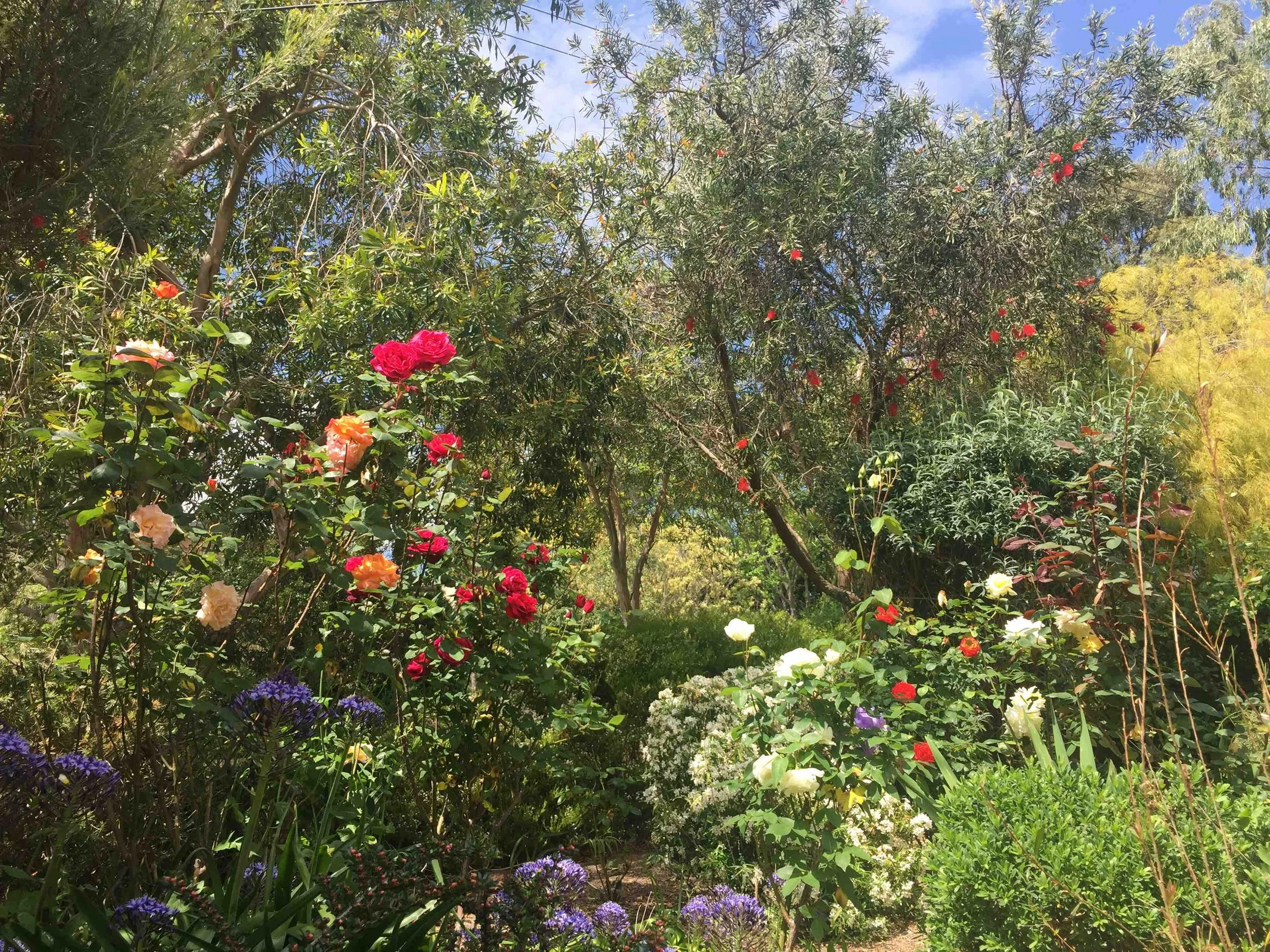
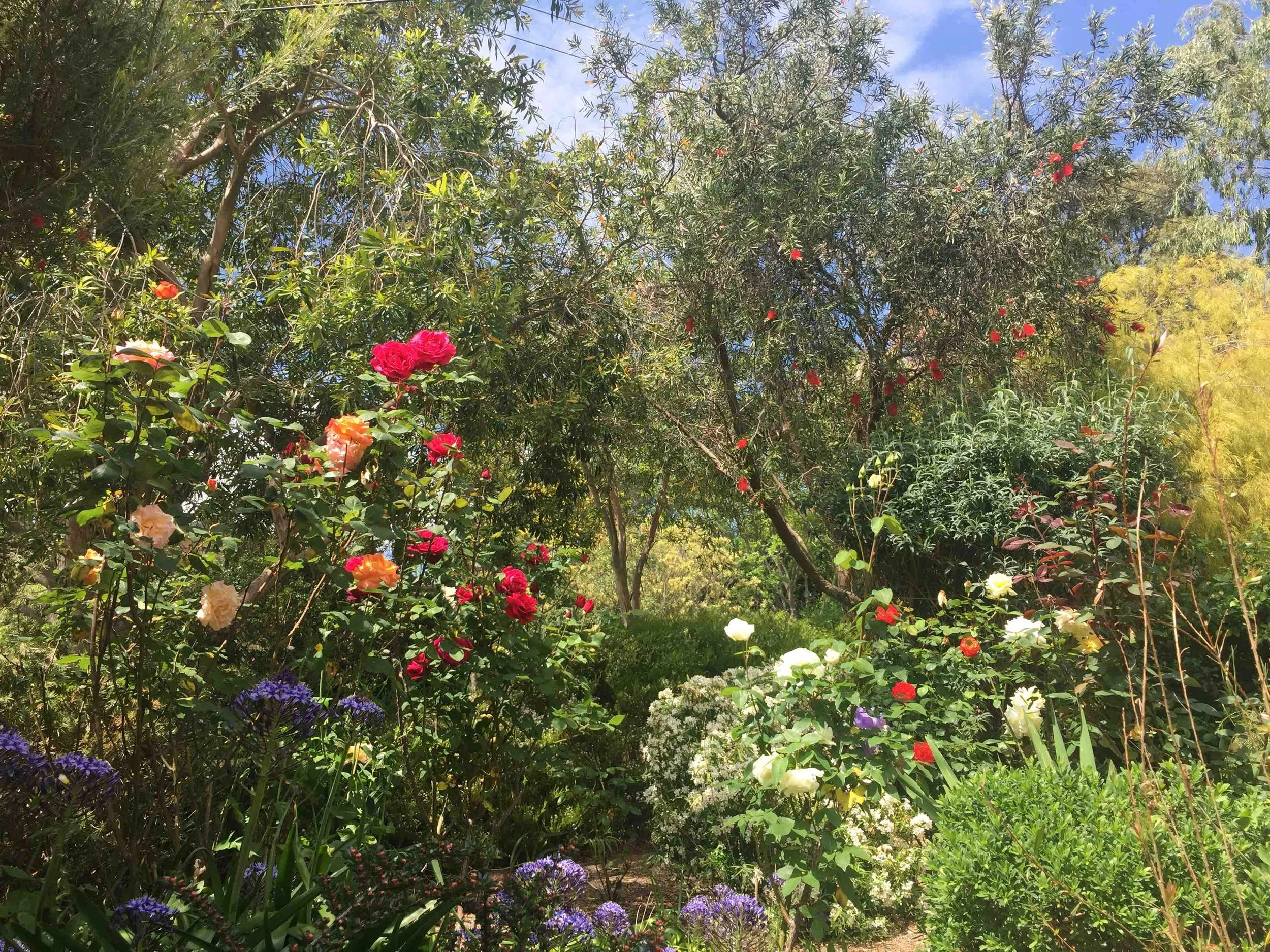
My Mother’s Garden in full bloom.
The family home, a changed future, and my father's invitation that set everything else in motion.
The invitation.
And how I ended up back living in the family home at almost fifty.
When my father, Ray, asked my husband, Jay, and me to come and live with him, the invitation carried years of family history.
There was a garden here long before Generate By Design, and long before I thought I might one day write about it. This is my family home. I grew up here, left, came back, left again, and eventually found myself living here once more at a very different point in my life.
After I survived meningococcal septicaemia in my twenties, my parents renovated and zoned the house so I could have a wing of my own. At the time, there was enormous uncertainty about what recovery would look like and whether I would be able to work again, so they reshaped the house around a future none of us could predict. I lived there for several years before eventually moving to Alice Springs.
The garden was a big part of Mum’s life. She was a passionate gardener, spending years layering Australian natives with more traditional planting, including English roses and bulbs. Great callistemons and banksias towered through the garden, alive with rosellas and parrots. At the same time, a wall of Acacia ‘Limelight’ along the front boundary had grown into an extraordinary green curtain between the house and the street. It was a mature, generous garden, full of the life that comes when plants have occupied a place for many years.
Mum’s health eventually meant that she could no longer remain at home. Leaving a place that meant so much to her and moving into care was a profound and painful change. This was her home, and losing the ability to live here was part of the grief of that period for all of us.
The idea of Jay and me making a home on the property had begun before Mum went into care. It had been her wish that we build a dwelling at the back of the property, replacing an old, dilapidated shed, and we had already engaged architects to explore what that might look like. It was a future she knew about and wanted for us.
After Mum died in 2022, Dad remained in the family home and invited Jay and me to come and live here with him. The arrangement was different from the one we had originally imagined. We would share the main house, while Dad would have another space of his own elsewhere on the property.
There was something deeply familiar about returning, yet something completely new about it too. I was coming back to the house my parents had once reshaped around my needs—this time with Jay, and with Dad inviting us to imagine the next chapter of family life here together. That chapter began in grief. What changed was the shape of the future we had imagined, and the fact that we were now making it without Mum.
In 2023, Dad engaged Humpy Co to create a new studio at the back of the property. Some of the great callistemons stood where that building would go, and as we began looking more closely at the garden, we also learnt that the wall of acacias along the front was moving through senescence. Some of the planting that had defined the property for years would have to make way for what came next.
Those decisions were considered carefully, with a deep understanding of what Mum’s garden had already given the house, our family, and the wildlife it had fed and sheltered for years.
Once the studio was built, the property presented a new question. The family home carried decades of history at one end, while this new building sat at the other. Between them was the garden, and suddenly, the relationship between all three mattered enormously.
The studio has since taken on another life as a counselling space for Ray Daniels Counselling and Third Chair Counselling, including the work Dad is developing to support dementia carers and their families.
By then, I had a strong sense of how I wanted us to live across the property. I wanted the garden to draw the old and new parts together—to feel lush and generous, to remain deeply Australian in its planting, and to create more opportunities for us to be outside. The front garden, in particular, needed to become a contained place where we could safely spend time with the dogs, rather than a landscape of beautiful, mature shrubs that left very little room for that kind of shared life.
At the end of 2023, Biodiverse Garden Design sent through their design. It arrived around Christmas, and I remember looking at it and feeling that somehow they had listened to everything I had been trying to express, translating it into something far more beautiful than I could have imagined.
The main house and the ‘Humpy’ were joined through the landscape. Spaces that had felt separate suddenly belonged to one another. Planting, paths, walls, and changes in level drew the property together while keeping it abundant, lush, and alive. It felt almost magical, and impossible to say no to.
In 2024, Outer Haven Landscapes began turning that drawing into the garden itself. I was there throughout the build, watching lines on a plan become walls, paths, planting, and places to move through. Questions would arise and be answered, materials would appear, plants would arrive, and day by day the property would change around us.
Then, the garden began to settle into itself. Plants reached towards one another, flowers appeared, birds found their way through, and the hard edges softened. The garden became fuller, richer, and increasingly its own.
As I watched that happen, I began adding my own: vegetables, herbs, flowers, and seedlings. I became interested in what could be propagated, what could be eaten, what could be placed in a vase, and how productive growing could enhance the garden's beauty.
Most of that productive layer is taking shape in raised beds, pots, and other deliberately composed growing spaces. I want the garden planted into the earth to remain overwhelmingly Australian native. In contrast, vegetables, herbs, fruit, edible flowers, and many of the plants I grow for cutting sit within it as another layer. Their containers and structures contribute form, height, repetition, and abundance while allowing the native landscape to remain the foundation.
That idea has become central to Generate By Design. Productive growing can be beautiful enough to belong to the composition of the surrounding garden, with food and flowers treated as part of its architecture and artistry.
Generate By Design emerged from that close attention, but its story begins much earlier. It begins with Mum’s garden growing around the family home, with a house my parents once changed to make room for the life I could live after serious illness, with a future we had imagined together taking a different form, and with Dad opening that home to Jay and me again.
That is the invitation the garden grew from.